Showing posts with label 2000s. Show all posts

Thursday, April 21, 2011

The Matrix: An Allegorical Model of Jesus


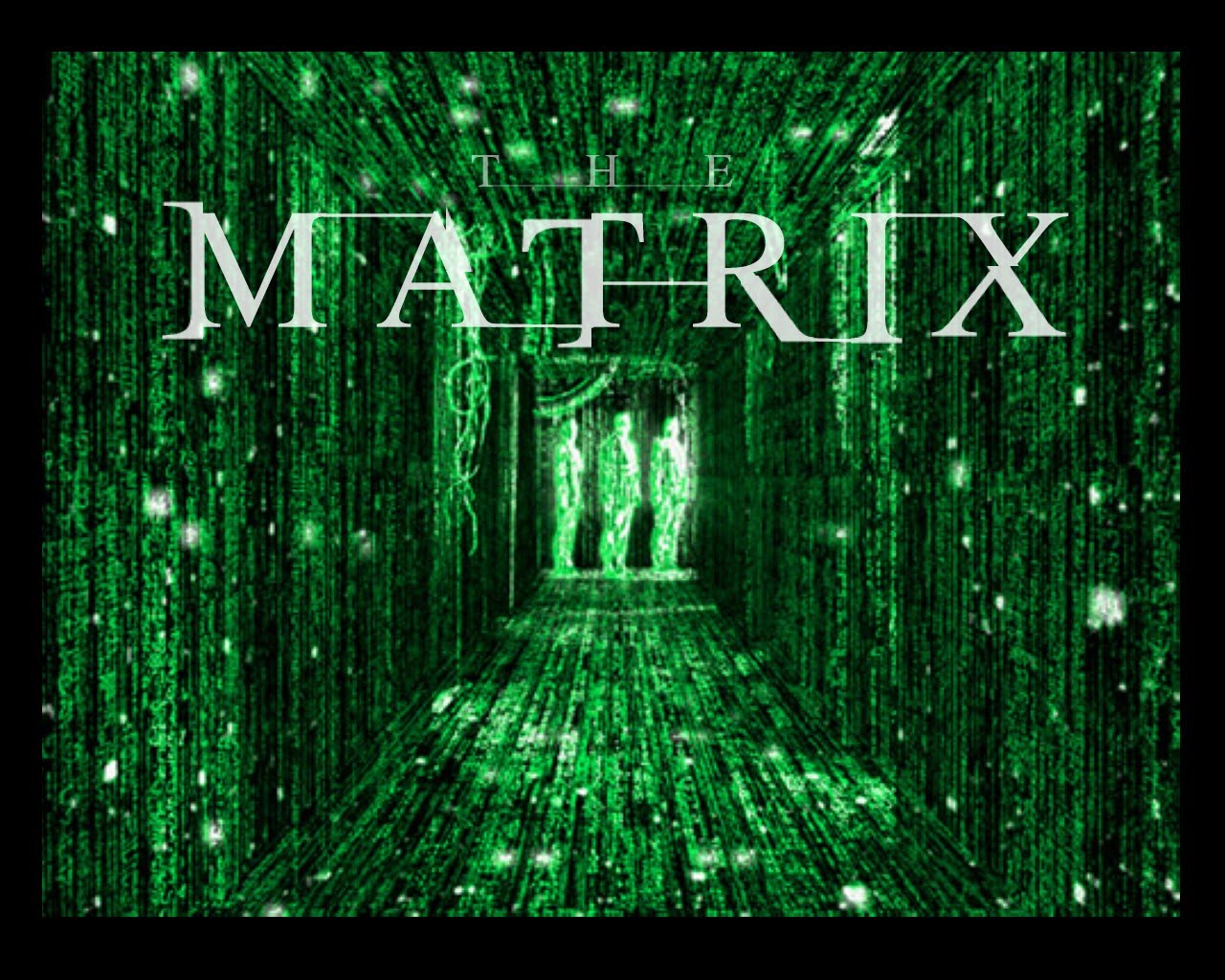
The Matrix came out in 1999 with good reviews and blockbuster weekends. It is a science-fiction action film written and directed by Larry and Andy Wachowski. The film has become a revolutionary film in that many of the actions scenes and cinematography challenged the audience and gave the next generation of films a higher standard to live up too. The innovative use of ‘bullet time’ has become popular in many current films.

The film’s story line begins with Thomas Anderson a computer hacker by night and normal business man by day. During his escapades as a hacker he finds mention of something called The Matrix but he cannot find what it is. He is lured out by a strange message on his computer to learn about the Matrix. Anderson meets the infamous hacker named Morpheus who tells him he can learn the real truth of the Matrix or continue on in his normal life oblivious to its existence, living life as normal. But Morpheus warns that if he travels the road less traveled to truth he will not be able to go back. Anderson is to choose between the blue pill, life as before, or the red pill, knowledge of the truth. He chooses the red pill.

Because of Thomas Anderson’s choice he now seems to take on the name of Neo, his hacker name, in the now real world. Neo finds that the world he knew was not the real world but one created by computers after a type of domes day that one could relate to in the movie Terminator. Computers are in control, using people as a source power to keep them functioning. People are grown in fields by the machines and never know what physical life is but live life only in a created mental state/world called the Matrix. Yet, there are some that have escaped and are building a world of free humans again called Zion.


The ragtag group that Neo is now joined with includes Morpheous, Trinity, Cypher, Tank, Mouse, etc. They all travel underground on a hover ship called The Nebuchadnezzar. Neo goes through numerous physical and mental changes as he accepts his new world and is trained to understand The Matrix limits and non-limits. Neo learns that in the Matrix your only limitation is your faith or belief in oneself. If you think believe you can do amazing feats then you can. The Matrix is a simulated reality and the laws of physics do not have to apply.

Neo is also taught that the machines know of the groups of renegades outside of the Matrix and they try to eliminate these pesky humans. The machines goal is to finding Zion and destroying all of these rebellious humans. In the Matrix are programs made by the machines to help identify the outside humans that infiltrate the Matrix trying to free other humans. These programs agents are to destroy anyone that is not to be there. The head of these agents is one called Mr. Smith.

There are other ships sent from Zion to do the same thing as the Nebuchadnezzar. What Neo also finds out is in their goal of freeing other humans that are ready to know the true state of reality that there is also a prophesy. The prophesy tells that there is One that will come and free all those trapped in the Matrix, bringing about a new order. Morpheous believes that Neo is the “One.” As the movie progress, Neo does seem to have something special about him as he can do more superhuman acts in the Matrix than anyone before him.

Allegory of the Matrix

Neo has been referred to as metaphorical Jesus figure in this movie. There are numerous symbolic reference that can be associated with Christianity throughout the film. Some have even pointed out that Christianity is not the only religion that this movie could have symbolic references too. Some belief there is Buddhism, Hinduism, Muslim, and Gnosticism.

During our class discussion many found that they did not care for the film or did not see the same symbolic references to a Jesus figure. There is a lot of violence in the film, for many this did not follow the teachings of Jesus. Some of the scientific technologies used where questionable in class discussion. There where some that could see the relevance of using certain scenes in the film for evangelistic use or in some from of Christian context.

Personally this is one of my favorite films, not necessarily as a Jesus film but high on my list. It has many great allegorical moment in the film that I have used for discussion with youth and my own children. For me, every time I see the film there is something new. As in the Bible I find when I read passages and reread them again later I find something new.

In this short blog, I feel I cannot even give a partial rundown of all the symbolic Christian meanings throughout the movie. I will point out a few highlights:

The name Thomas Anderson give a rendition of a doubting Thomas, as one of the disciples of Christ, or even Christ question his role and actions in the garden. The last name of Anderson in the Greek form means Son of Man.

The reference to the Matrix as not the real truth and reality, living in a world where many are deceived. The idea that we all ultimate have the choice of free will, to choice truth (Christianity) or continue living life as normal, either ether blue pill or the red.

When Neo choose the red pill he goes through a process that can be associated with Baptism into Christianity. He then is followed through a learning stage in his new life. Later he is then faced with temptation and other choices.

Morpheous is taken by the agents and tortured to the point of death. Neo goes to save Morpheous and calls him out by telling him to wake up. This could parallel the raising of Lazarus. Another algological figure is Cypher, the Judas figure that turns all of them over the agents for his own benefit.


Near the end Neo is finally cornered by the agent Smith. He is shot. It has been portrayed in the movie if one dies in the Matrix you are dead in real life, since the mind cannot differentiate from the too, your life ends. As Neo dies in the Matrix his body also dies in the real world. Yet, Trinity believes he is the One of the prophecy and tells him that she also loves him. Seventy-two seconds after Neo dies he comes back to life. Parallel to the three days of Christ’s dead and resurrection. Neo no longer can be beat by the agents but can now destroy them.

Conclusion

This is not an exhaustive list of allegories in the movie The Matrix. Personally I recommend you see it for you self. It may not be one that you care for as many in class did not but you never know. There are many other movies that also give allegorical representation of a Jesus figure. You may even find a new one, since many new movies come out weekly.

I have and will continue to use this movie and certain clips as a teaching tool. Hopefully giving new incite for thought in how Jesus is for all people.

Films are entertainment but also can be much more. I hope that in the future you too will find benefits outside of entertainment value. Now go watch a movie and enjoy some popcorn!

Monday, April 18, 2011

"Who is this 'Son of Man'?"

(John 12:34)
Under the unassuming title "Son of Man," South African director Mark Dornford-May presents a powerful retelling of the story we all thought we knew. Son of Man (2005) relocates Jesus in modern-day Africa, with lively local music and refreshingly commonplace characters. Though the basic plot follows the biblical account, the setting and style effectively defamiliarize the gospel story. With the grave-clothes of familiarity cast aside, the gospel is resurrected for a modern world in desperate need of "good news."
From the start, the audience knows this will not be the average Jesus film. It opens, unconventionally, with the temptation narrative. This confrontation between Jesus (Andile Kosi) and Satan (Andries Mbali) establishes the film's central theme – "good versus evil," or, more accurately, "justice versus injustice." This programmatic scene reaches its climax as Satan claims, "This is my world" and Jesus objects, "This is my world." The film progresses as a trial of these competing claims. Dornford-May has thus subtly altered the significance of the temptation. In the gospels, Jesus rejects temptations of worldly dominion in order to proclaim the kingdom of heaven. In Son of Man, he rejects Satan's power over this world and begins his ministry of bringing justice on earth.
The colors white and black function symbolically throughout, making the conflict visible. At the temptation, Jesus appears dressed in white and covered in white paint, while Satan is clothed in black and resembles a dark shaman. Beyond the cliche white-black dichotomy may lie a contrast between light and darkness (c. Jn. 3:20-21; Eph. 5:8-14; 1 Jn. 2:8-11). Darkness implies deception, which is satanic (Jn. 8:44b). The so-called "Democratic Coalition" presents a facade of legitimacy through duplicitous rhetoric. Acts of violence are denied and literally covered up (the massacred boys are covered by a blanket, people "disappear," Jesus' body is hastily buried). In contrast, the movement around Jesus "brings to light" injustices which have gone unchallenged because they are hidden. Thus we see Mary turn her son's face to witness the murder of his peers and later hear Jesus repeat "when...evil still exists in the world." Most striking is the reversal of cross-burial; in this telling, Jesus is murdered at night, in secret, and placed in an unmarked grave. Mary uncovers his body and places it on a cross, lifted high in broad daylight for all to see. The cross is transformed from a symbol of redemptive suffering to a proclamation that violence cannot bring peace. Injustice draws power from lies and fear; when the community unites under the cross with the courage to face the truth, their victory has already begun.
The message is decidedly this-worldly and human; the absence of "God" or "heaven" in Jesus' preaching is noteworthy. The revised Sermon on the Mount (an address in a shanty-town hut) diverges from Matthew's version (Mt. 5-7): People must not get bogged down by "moral trivialities" (personal sin) or they will lose the struggle against "real sin," which is institutional evil. Dornford-May's Jesus proclaims faith in "the inherent goodness of man" and calls people not to believe in him as Savior but to join in his mission: "We lead ourselves to glory or destruction." Likewise, the divinity of Jesus is essentially insignificant. He is the leader of a movement, not the savior of the world. The real triumph occurs after his death (and before the resurrection!), when his followers embody his commitment to non-violent resistance. By placing the Pentecost moment before the Resurrection, the film suggests that human rather than divine action is the cause (and significance?) of the resurrection.
The prominence of the supernatural in Son of Man seems at first incongruous with its anthropocentric message. Beneath the surface level, however, the way the supernatural elements function may actually suggest their irrelevance. The angels watch but never interfere. In one of the most poignant scenes, Mary (Pauline Malefane) angrily confronts an angel for allowing the massacre she has just witnessed. The angel remains silent. The child Jesus then rejects the angel's summons as he rejects Satan: "This is my world." From that point on, angels appear only on the periphery. Satan never acts directly either, despite frequent appearances. The goat staff he carries appears in the hands of a corrupt leader, suggesting that "Satan" is merely the abuse of power by human beings. Satan looks upon Jesus' brutalized body with glee, but the violence was perpetrated by human beings. In a similar way, Dornford-May portrays miracles only indirectly, through the videos of Judas and the murals of the community. Judas's colorless film conveys the literal events, which "prove nothing," while the fanciful murals demonstrate true understanding. Even the most miraculous gospel events, the Incarnation and the Resurrection, are bound to human action – Mary's display of solidarity with the victims of violence and the community's courageous act of nonviolent resistance. This portrayal suggests that whether or not supernatural forces are present, the struggle for liberation rests solely on the shoulders of human agents.
The biblical quotation at the end of the film plays off of the title screen at the beginning, for a framing effect which drives the message home. The post-script - "And God said, 'Let us make man in our image'" - explains the significance of the title: Here, "Son of Man" is not synonymous with "Son of God," but with "Man" (i.e., a member of humankind). The title stands out because "Son of Man" is never applied to Kosi's character in the dialogue. Even the name "Jesus" is explicitly mentioned only at the Annunciation. This "Jesus" may be viewed as a sort of Everyman. His clothing and demeanor do not distinguish him from the crowds in any way, nor does he draw attention to himself. He is a (mostly) ordinary person whose message of unity and non-violence empowers other ordinary people. The implication is that if the Kingdom of God is to come on earth, God's image-bearers must bring it.

Tuesday, April 12, 2011

The Passion of the Christ (2004, Mel Gibson)


Brief summary of the film

The Passion of the Christ is a 21st Century film which portrays the last twelve hours of Jesus Christ before he was crucified. The movie is in Aramaic and Latin and that definitely gives it a different feel. The movie seems to start in the middle of everything and we join in when Jesus is in the Garden of Gethsemane praying. Interesting enough and unlike other passion plays/movies, Satan appears to Jesus in the Garden and has a conversation with him. Jesus doesn’t really pay Satan too much attention and eventually Satan disappears.


In the beginning of the movie, we don’t see Judas betraying Jesus but we can assume it has already happened because Jesus is arrested and the movie takes a different turn. The Pharisee’s bring Jesus to Pilate so he can decide if he will be saved or condemned to death. The pharisee’s tell Pilate Jesus’ crime and but Pilate responds by handing the matter over to King Herod. Herod (who seems to be hung over or maybe recovering from a night of festivities) laughs at the matter, thinks Jesus is crazy, and has him sent back to Pilate.


Pilate gives the crowd a choice, Barabbas or Jesus – crowd picks Barabbas and Jesus is handed to the Roman solders to be whipped. This happens repeatedly with a strip of leather with spikes on it. He is whipped front and back and viewers watch as the blood oozes out of Jesus’ back and stomach. The solders inflict pain but are careful not to kill him (just yet). They bring him back to Pilate, who literally washes his hands and walks away. Jesus carries his cross and is eventually hung till his death. This movie has a lot of interesting symbols included in the midst of al the violence such as the snake that appeared in the garden while Jesus was praying. I’m not really sure what that was supposed to mean but If Satan had not appeared during that scene I would have thought the snake would have symbolized Satan’s presence in the garden with Jesus. When I see children in Jesus films, I usually think of what Jesus said in Matthew 19:14, Jesus said, "Let the little children come to me, and do not hinder them, for the kingdom of heaven belongs to such as these." In this movie, children are portrayed as little devils and Satan can be seen caring a child while Jesus is being whipped children. The children are also seen tormenting Judas to his death and image can be disturbing. Maybe Mel Gibson wanted us to see that evil can also be found in what looks innocent and If Satan can use a serpent, then why not a child.

Style and era it was made


This film was released in the United States on Ash Wednesday, April 25, 2004. I find it interesting that this movie would premier on a night when millions of people are beginning their forty days of prayer and fasting. Lent gives us time to reflect on the life and suffering of Christ. Some take this time to repent, meditate, and ask what Jesus would do? This movie is not in English but it was filmed in Aramaic and Latin. I believe this was a way for the film to show its authenticity. This film was well received and while Gibson says he made this film for the unbeliever, I believe it has an evangelical feel to it.


Films intentions and emphasis


“My intention for this film was to create a lasting work of art and to stimulate serious thought and reflection among diverse audiences of all backgrounds,” says Gibson. Gibson wanted to stimulate serious thought and reflection and that he did. The movie is rated R for “sequences of graphic violence” and blood is the result of this violence and in my opinion the intention.


"The ancients believed that blood was the seat of the emotions.” Blood is a universal, cultural, biblical, and sacred symbol that has different meanings for a lot of people. From the time Jesus is arrested, this movie shows a lot of blood. I’m not sure what’s worse, the violence or the amount of blood that is spilled. In the bible, blood is sometimes used metaphorically to present sacrifice and suffering. I would say Gibson wanted to use blood to stir up emotions of guilt. I also believe Gibson wanted his audience to think of the blood Jesus shed for the atonement of sins and also have an awareness of having done wrong or committed a crime, accompanied by feelings of shame and regret. Mel Gibson also says “my ultimate hope is that this story’s message of tremendous courage and sacrifice might inspire tolerance, love and forgiveness. We’re definitely in need of those things in today’s world.” I agree with Gibson that we are always in need of tolerance, love, and forgiveness but I don’t think this movie stirred up those feelings nor would I walk away thinking tolerance, love, and forgiveness can only be found in the church or through the suffering of Jesus Christ.


Audience for this movie


Maybe Mel Gibson was incorrect when he said he made this movie for the unbeliever because this film does not offer enough information about the life and teaching of Jesus to get an unbeliever to raise questions about faith and Christianity. This film starts in the middle and for the rest of the movie, we see a man that is tortured and does not have a problem hiding his mental and physical pain.


The perfect audience for this film would be evangelicals, biblical scholars, and church study groups. These audiences will probably have background information about what is going on without raising too many questions about who Jesus really is and why he suffered the way he did. Due to the violence, I would also add this movie is not appropriate for young children or maybe even the elderly. Passion is a word that means the suffering of Christ. Mel Gibson titled this film The Passion of the Christ and that is exactly what we saw, the suffering of Jesus Christ.

Monday, April 11, 2011

Gibson’s The Passion of the Christ? Successful Guilt-Trip or Bad Horror-Movie?

Why did Mel Gibson’s The Passion of the Christ move some to conversion or repentance while leaving others cold? While acknowledging that a plethora of personal, relational and cultural factors contribute to the manner in which any individual receives a movie, this piece contrasts two possible responses. First it considers the response of those who buy into a theology of substitutionary atonement. This group includes most Evangelical Christians and also the “unchurched” who are often familiar with the assumption that “Jesus died for our sins” and have not subjected this position to critical reflection. Second, I consider the reaction of those who have reservations about models of atonement rooted in vicarious blood-letting and either reject or qualify such theologies. This group, I will argue is more likely to experience The Passion as horror movie than as a call to repentance.

There may be a curious sense in which Evangelical Christians and the “unchurched” are both likely to endorse a theology of substitutionary atonement, that is, the view that Jesus died to pay a debt incurred for all humankind by the sin of Adam and Eve. Evangelicals generally reject other models of redemption while the unchurched are often unaware of the theological alternatives. While defending himself against the charge of anti-Semitism, Gibson revealed his thinking on blood atonement. Gibson was asked about the choice to maintain in the script the words from Matthew’s Gospel, "His blood upon us and on our children!" (Mt. 27:25) but not to include this line in the subtitles. Gibson’s response was:

"I wanted it in. My brother said I was wimping out if I didn't include it. But, man, if I included that in there, they'd be coming after me at my house. They'd come to kill me." (The New Yorker, September 7, 2003, Perri Dorset)

On another occasion, Gibson elaborated with regard to this passage:

"It's one little passage, and I believe it, but I don't and never have believed it refers to Jews, and implicates them in any sort of curse. It's directed at all of us, all men who were there, and all that came after. His blood is on us, and that's what Jesus wanted." (Terry Lawson, "Mel Gibson and Other ‘Passion’ Film-makers say the Movie was Guided by Faith", Detroit Free Press, 2004).

Hence Gibson sees his audience as in some sense responsible for the violence on screen. Gibson claimed that the made the movie primarily with the unchurched in mind, a group for whom the guilt-trip might evoke “prodigal” pasts. (Leslie Smith, Living in the World but not of the World Walnut Creek: Alta Mira Press, 2004, p. 47)

To be fair, atonement theology takes many forms including St. Anselm’s theory of substitutionary atonement wherein God is no sadist baying for blood but a rather impotent deity constrained by some cosmic version of the feudal honor code from forgiving the sin of humanity. In contrast, some models of substitutionary atonement in modern fundamentalism purport to know the will of a God who preordained the suffering and death of Jesus. Such views persist in contemporary ultra-conservative Catholicism, for example, in the work of Scott Hahn. The point for this movie is that such theology can lead to the conviction that ones own sins somewhat contributed to one of those lashes, blows, nails, thorns or falls.

The irony is that for the vast majority of viewers, Jesus’ blood sacrifice was, in Gibson’s view, ineffective. Peter J. Boyer's “The Jesus War: Mel Gibson & "The Passion" (9-15-03) identifies a source of major dissension that was swept under the shroud. Boyer writes:

"I told Gibson that I am a Protestant, and asked whether his pre-Vatican II world view disqualified me from eternal salvation. " He paused. 'There is no salvation for those outside the Church,' he said. 'I believe it.' He explained, 'Put it this way. My wife is a saint. She's a much better person than I am. Honestly. She's, like, Episcopalian, Church of England. She prays, she believes in God, she knows Jesus, she believes in that stuff. And it's just not fair if she doesn't make it, she's better than I am. But that is a pronouncement from the chair. I go with it.”

On a related note, whether or not the Passion can fairly be described as anti-Semitic, Gibson’s remarks may indicate the eschatological fate he imagines to lie in store of Jews. Gibson rejects Vatican Two’s Declaration on the Church’s Relation to Non-Christian Religion (Nostra Aetate). Still, presumably Gibson grants salvation for Jews like Miriam of Nazareth a.k.a. Mary the Mother of God, Cephas Son of Zebedee a.k.a. St. Peter, the other apostles and the patriarchs and prophets of the Hebrew Bible. At least, Gibson concedes Resurrection to Jesus –Bar –Joseph from Nazareth.

I posit that the movie may be received very differently by those who either reject or significantly qualify theologies of blood atonement. Such positions include those that locate the savific value of Jesus death in its moral example, those who emphasize the value of Jesus’ life and who see the cross as the culmination of evil, rather than of God’s will, and those who appeal to the Biblical understanding of blood sacrifice as celebratory, reuniting blood (signifying life) with the giver of life. Those who embrace the insights of the thrust of modern biblical scholarship are unlikely to view Jesus’ death as payment for the personal sins of a historical Adam and Eve or for any individual living or deceased. Some might point to the role of systemic/ institutional/ social sin in bringing about the death of Jesus. These and other interpretations of the death of Jesus other than substitutionary atonement are not conducive to a personal guilt-trip. Indeed for viewers so persuaded, the movie may hold more in common with the genre of the horror-movie. By contrast, it could be argued that the Evangelical audience is likely to be less au fait with horror movies and hence less prone to the conditioned stock-responses to which that genre can give rise.

This movie exhibits elements of the two sub-genres of “slasher” movie and supernatural thriller. The movie out-bleeds most slasher movies, arguably numbing the viewer to its effects. A classification of the movie as a supernatural thriller reflects a Satanic presence, manifested in apparently feminine form, arguably impelling the relentless assault on Jesus. Indeed, Jesus’ adversaries, Roman and Jewish behave as though possessed, their apparent delight in unspeakable violence otherwise inexplicable. A legion of demons infests the movie, its presence sometimes ambiguous as to whether an objective manifestation or the subjective nightmare of a character is being conveyed.

It was my initial intention to make the claim that a movie received as a horror-movie must fail to move the religious sensibilities of a media-savy audience. However it may be fairer to say that a bad horror movie cannot move religious sensibilities. This qualification may be appropriate since, in the sub-genre of the supernatural thriller, particularly those concerned with the battle between Christians and oppression by supernatural evil, some powerful movies are to be found. The last bastion of the “hero priest” may be in this subgenre. This is be true to some extent for The Exorcist (1973, William Friedkin) but, even more so, I would argue for The Possession of Emily Rose (2005, Scott Derrickson,) and The Rite (2011, Mikael Håfstrom) both movies claiming some basis in actual cases (as is also the case for The Exorcist) These movies testify to the courage and selflessness of the exorcists who are inspirational, Christ-like figures and fully developed characters with whom the viewer might empathize. Even zombie movies, notably Twenty-Eight Days Later (2002, Danny Boyle) can, albeit rarely, poignantly rehearse the nobleness of self-sacrifice in the face of hopeless adversity. This acknowledgment of the religious possibilities conceivably possible in the genre broadly termed “horror” may be all the more damning for The Passion.

In conclusion, it may be for the following reasons that The Passion fails to move the religious sensibilities of many: (1) Critical thinking kicks in, raising questions about the salvific value of blood-letting so that a visceral reaction is supplanted by an intellectual one. (2) The excessive blood and violence approach the farcical and numbs the sensibilities of the viewer. (3) The lack of character development inhibits identification with a credibly human Jesus. (4) Absent also is the development of an agenda of hatred, making it difficult to comprehend the motives of Jesus’ torturers. Instead we witness mindless brutality by an array of ghouls who seem to have strayed off the set of Dawn of the Dead to which The Passion would yield its box-office position. (5) Any depiction of intelligible human motivation seems to be replaced by an implied supernatural influence. (6) The “slasher” element and the “exorcist” element combine so that some receive the work as a horror movie. With some notable exceptions, the conventions of the horror movie offer a safe distance between viewer and action so that the savy viewer is unlikely to be cut to the core, each time the zombie’s devour another victim. The movie may offer an effective guilt-trip for those who believe their personal sins contributed to the execution of Jesus. On the other hand, for those who relate the events upon which the movie is based to institutional evil and moral complexity, the mise-en-scène is too remote from their concerns to evoke much more than distaste at the spectacle of an hour-long slaughter.